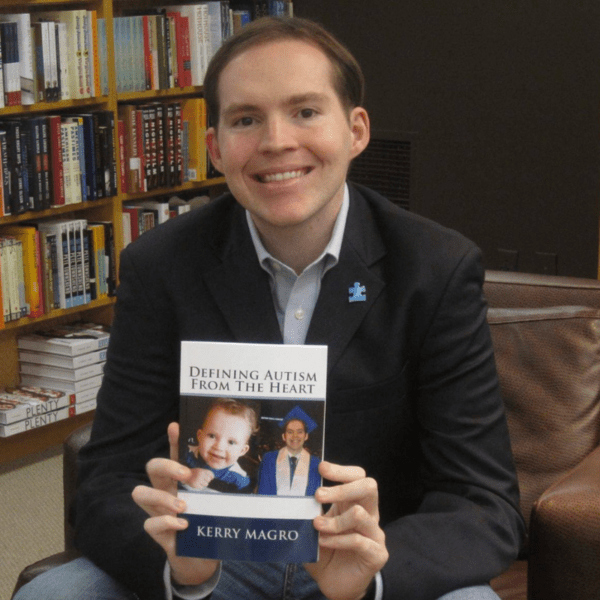

This guest post is by James who is undecided on university currently. James is applying for the Spring 2026 Making a Difference Autism Scholarship via the nonprofit KFM Making a Difference started by me, Kerry Magro. I was nonspeaking till 2.5 and diagnosed with autism at 4 and you can read more about my organization here.
Autistics on Autism the Next Chapter: Stories You Need to Hear About What Helped Them While Growing Up and Pursuing Their Dreams was released on Amazon on 3/25/25 and looks at the lives over 75 Autistic adults. 100% of the proceeds from this book will go back to supporting our nonprofits many initiatives, like this scholarship program. Check out the book here. Would you like me to travel to speak with your school or company on autism and inclusion? You can contact me here for more details.
I spent two years of my life in residential treatment, but I did not let it define me. Instead, it became the turning point that helped me rediscover who I was and who I wanted to become.
Emotion flooded through my body as I stood before my 26 peers at my treatment graduation. I had attended many ceremonies before, watching other students walk across the room with confidence and pride. I admired them deeply, wondering if I would ever feel that same sense of accomplishment. On that day, I realized I had become one of them. Despite being 2,178 miles away from home, I had never felt closer to myself.
Growing up autistic without a diagnosis was one of the most confusing experiences of my childhood. I was not officially diagnosed with Autism Spectrum Disorder until I was sixteen. For years, I felt out of place without understanding why. As a child, I experienced selective mutism that made social situations overwhelming and isolating. I often believed something was wrong with me rather than recognizing that my brain simply worked differently.
By my sophomore year of high school, my mental health had deteriorated significantly. The exhaustion of masking, academic pressure, and emotional distress became too heavy to carry alone. After many sleepless nights and difficult conversations, my family and I made the decision for me to attend a residential treatment center. Leaving my parents and three siblings to live across the country in a house full of strangers was terrifying. It felt like surrendering the last pieces of normalcy I had.
But surrendering turned out to be the bravest thing I could have done.
In treatment, I learned structure. I learned distress tolerance. I learned executive functioning skills that I had struggled to develop on my own. Most importantly, I learned that asking for help is not weakness. For someone who had spent years feeling different and misunderstood, that realization was life-changing.
Treatment provided space for reflection and growth. Through therapy and daily routines, I began to understand how my autism intersected with my mental health. I started recognizing my sensory sensitivities, communication challenges, and emotional processing patterns not as flaws, but as parts of me that required support and understanding.
As I gained confidence, I began turning inward healing into outward action. I have always been passionate about social justice, but for a time, that passion had dimmed under the weight of depression and anxiety. In treatment, I reclaimed it. I sought out volunteer opportunities and discovered meaningful work in preschool classrooms at the Jean Massieu School of the Deaf. Supporting Deaf students and engaging with the community reminded me that advocacy can take many forms. Even while balancing the demands of my program, I fought to create space for the causes that mattered to me.
Through this journey, I developed resilience rooted in self-awareness. I learned to compartmentalize when necessary, to prioritize responsibilities, and to show up even on days when everything felt heavy. Recovery did not mean the absence of struggle. It meant having tools to navigate it.
For much of my childhood, I believed that being autistic made me “too much” or “not enough” at the same time. Treatment helped me unlearn that narrative. It allowed me to see that my differences also fuel my empathy, my sense of justice, and my determination to create equitable spaces for others.
While my path has been unconventional, I would not change it. Accepting help was the most important decision I have ever made. Graduating from treatment was not the end of my journey. It was the beginning of a life rooted in self-understanding and purpose.
Today, I approach the future with equanimity and confidence. I know that challenges will arise, but I also know that I have the skills to face them. My experiences have strengthened my desire to pursue higher education and dedicate my life to supporting students who, like me, once felt out of place.
I am no longer afraid of being different. I am proud of how far I have come, and I am ready to use my voice to advocate for a more just and inclusive world.
Kerry Magro, a professional speaker and best-selling author who is also on the autism spectrum started the nonprofit KFM Making a Difference in 2011 to help students with autism receive scholarship aid to pursue a post-secondary education. Help us continue to help students with autism go to college by making a tax-deductible donation to our nonprofit here.
Kerry Magro, a professional speaker and best-selling author who is also on the autism spectrum, founded the nonprofit KFM Making a Difference in 2011 to help students with autism receive scholarship support to pursue post-secondary education. You can help us continue supporting autistic students by making a tax-deductible donation to our nonprofit here.
You can also consider having Kerry speak at your next event by submitting an inquiry here. Kerry speaks with schools, businesses, government agencies, colleges, nonprofits, parent groups, and conferences on topics including autism, employment, college success, mental health, inclusion, and bullying prevention.