
This guest essay is by Taylor Reed (a pseudonym). Taylor is an autistic student who cares about making education more welcoming for autistic children. She shares what she learned about accommodations, self-advocacy and becoming more comfortable with her disability.
Published under a pseudonym at the applicant’s request. Identifying details have been generalized to protect privacy. The accompanying image is a stock photograph.
It was only when I entered pre-school that I noticed I was different from other children. Where others were able to keep quiet, sit still, and follow classroom instruction I did quite the opposite. Socially, I struggled to make friends. Speaking to neurotypicals felt like speaking two entirely different languages, being from two entirely different planets, even. I was an alien amongst my peers. Physically, it was just as bad. I couldn’t dull any noise, smell, taste, etc. I was left with even less emotional regulation than the average toddler because of this, and would cry and break down at least weekly. When I reached kindergarten, the initial awkwardness escalated into severe bullying, of which most of my teachers knew about. I suspect my teachers either didn’t know what to do with me, or even actively resented me for making their job harder. I was a very difficult kid. I regularly had outbursts, along with moments of vindictiveness and lying. The bullying continued for two years, and eventually got so bad I had to be moved schools.
When I was in second grade, I was diagnosed with ASD (Autism spectrum disorder) and ADHD (Attention deficit hyperactivity disorder). Rather than this being a moment of clarity for me, it was one of deep shame. My brother is autistic and I saw the way people treated him, including family members. By that time, I had internalized that “autistic” didn’t mean pride, accomplishment, or even humanity. It was a black mark on you that would shift the way people saw you forever. I rarely told anyone I was autistic. I’d often get back handed compliments in the way of: “being so smart for an autistic person.” This led to a strong internalized anti-autistic sentiment within me. In reality, I was no less human or worthy of respect than my neurotypical peers. But I had already taken what they’d reinforced to me as fact.
This had a long, detrimental effect on my schooling. For a long time, I was scared of using the accommodations that my school provided. I already stood out, and I felt as if I would be drawing more attention to myself by using them. I wanted to prove I was just like my neurotypical peers; that I could do everything they could, or better, with the same tools. I did not need to use “crutches” to succeed.
My mindset was fueled by shame. This was detrimental to me, especially in junior high. Where I had previously been scoring As and Bs, I was now dropping to Cs and even Ds in some situations. I refused to advocate for myself. My social worker would often have to pull me aside to force me to talk to her. For no reason other than pride, I felt inferior for needing accommodations. I hadn’t realized at the time that not having the same needs as my neurotypical peers did not make me any less; I believed difference meant inferiority. I held myself to neurotypical standards that had a catastrophic effect on my education, as well psychologically. I put myself through a very, very intense process of masking that only resulted in me repressing most emotion. Even now, I am so disconnected to many of the emotions I felt fully as a child because I was so dead set on repressing my autistic traits.
While my negative mindset was detrimental, my lingering determination to prove I was just as capable uplifted me. When I moved, I had a clean slate. College was approaching and school had gained a new weight. I had to swallow any shame I felt before, and use my accommodations. It was still difficult at first, as my social worker still had to pressure me quite a bit. However, I communicated more effectively, and advocated for myself. My grades improved and I became much more relaxed at school. Now, I use my accommodations daily. I even received them at my community college, and did so by communicating with the accommodations office myself. I learned that it is okay to need more help, and further, I learned to be more comfortable with my disability.
Recently, I have also gone through the process of attempting to unmask, to feel the full extent of my emotion. I allow myself to stim more often, let the performance drop around my friends, and I’m beginning to access autistic joy that I haven’t had in years. My advice to other autistic people is to avoid holding yourself to standards that are not only not built for you, but actively meant to shrink you as a person.
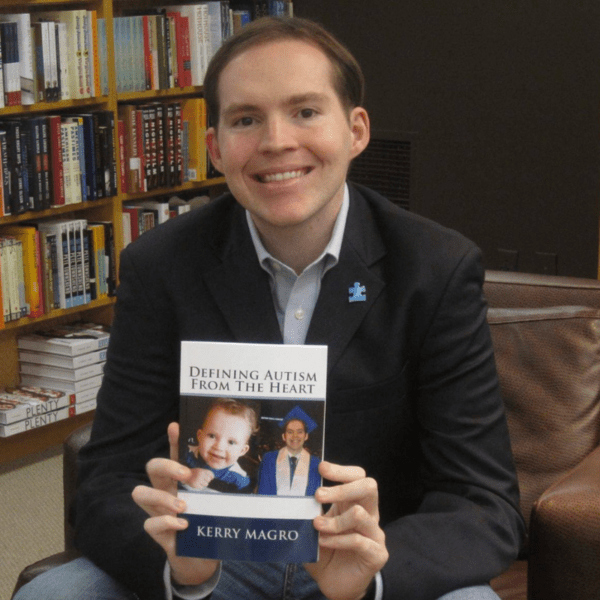
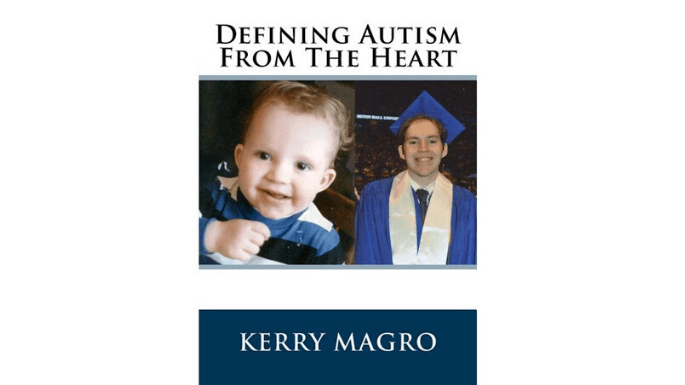
This essay was submitted to the KFM Making a Difference scholarship program, founded by Dr. Kerry Magro to support autistic students pursuing postsecondary education. Publication does not announce a scholarship award.
Learn about Kerry’s speaking programs or support the scholarship program.