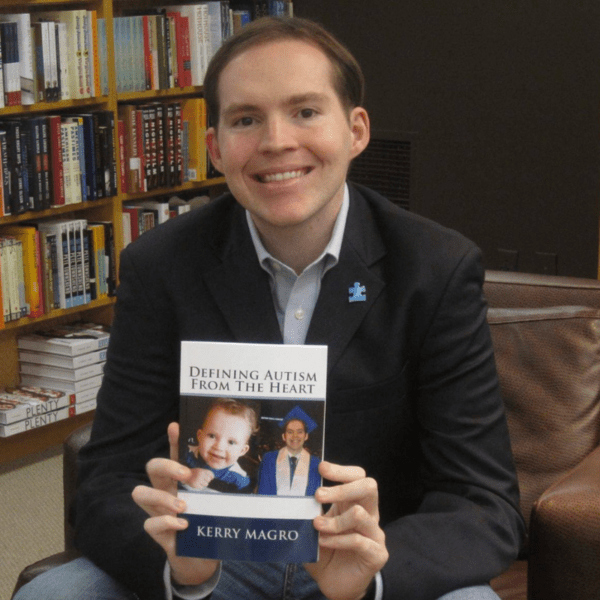
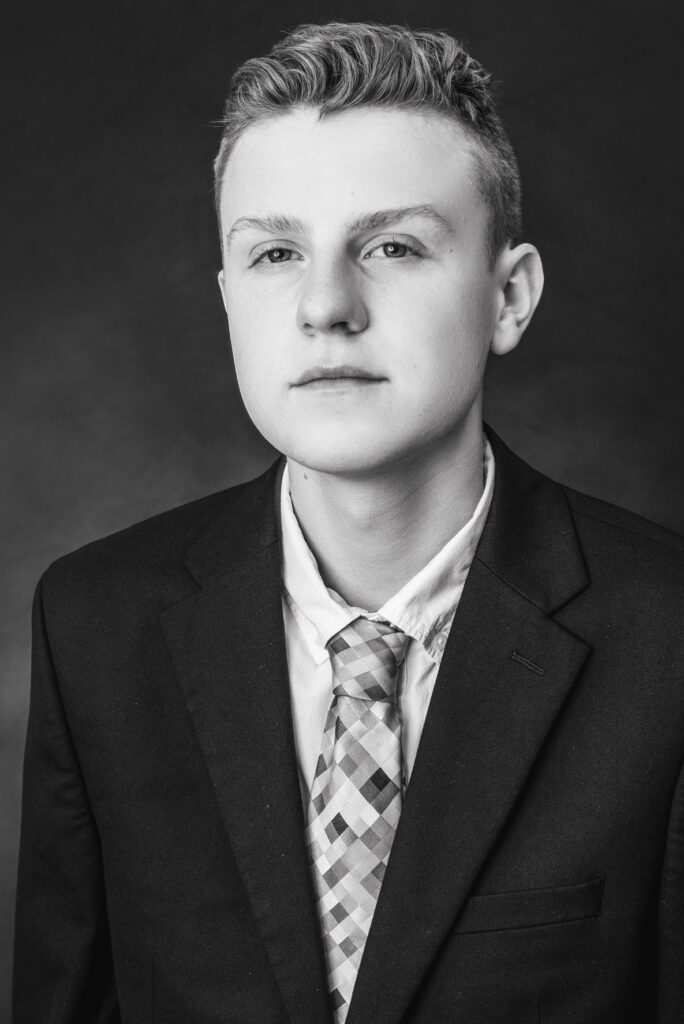
This guest post is by Alex Harrison, an autistic student at Arizona State University studying innovation in society with minors in business and French. Alex enjoys reading, building Lego sets, and spending time with his family. He is applying for the Spring 2026 Making a Difference Autism Scholarship through KFM Making a Difference, the nonprofit founded by Kerry Magro. Kerry was nonspeaking until age 2.5 and was diagnosed with autism at 4.
Autistics on Autism: The Next Chapter shares stories from more than 100 autistic adults about what helped them while growing up and pursuing their dreams. All proceeds support KFM Making a Difference initiatives, including this scholarship program. To invite Kerry to speak at your school, company, or organization, submit an inquiry here.
My name is Alex Harrison, and I am looking to enhance your knowledge of a challenge I had. I hope you enjoy this story.
Someone walks into a room and right away you notice something different about them. Maybe it’s the fact that they’re wearing a winter coat even though it is summer, maybe it’s the fact that they are carrying a stuffed toy despite being high school age, maybe it’s the way they talk to themselves or flap their hands or bounce up and down while they walk or any number of other curious behaviors. No matter what there’s one thing you involuntarily think: “that kid is weird.”
My name is Alex Harrison, and I am a weird kid. My behaviors have been perceived as weird because I have autism. My autism diagnosis has filled my life with both blessings and sometimes difficult challenges.
When I was twelve, my parents sat me down on the couch and told me that I had a “small bit of autism.” My parents had suspicions for several years, but I was around 7 years old when my first psychologist made the diagnosis. Around this time, I also knew deep inside that I was different, and I thought that something had to be wrong with me, so I had begun doing research on various conditions, reading books and articles far beyond my age, and presenting my findings to my parents in a rather offhanded and autistic way by saying things like, “I don’t think I have a brain tumor… or I don’t think I have cancer.” The term autism was still a big shock even though I finally had an answer to my biggest question! My diagnosis was described as Asperger’s syndrome. Over time, I have learned more about autism spectrum disorder and the many different ways autistic people experience the world.
While I said I was fine at first, when I was alone and thinking about it later, I began to worry because I thought that autism was a degenerative disease like dementia and that I wouldn’t be able to talk when I was an adult. I had only the barest perceptions of it based on what I had seen in the media. I felt worried about these perceptions becoming real and affecting my future growth. My parents clearly understood the anxiety that an autism diagnosis would produce in me and chose to withhold that information until I was older instead of sharing it with me right away as soon as they learned themselves. In the following years I have come to understand my diagnosis more and more.
That being said, there are those who did not understand it. One of these people was my second grade teacher. My second-grade teacher’s classroom management strategy relied solely on peer pressure and bribery. She would award ‘bear points’ for compliance with her rules, which were often arbitrary and varied from situation to situation. I would remove myself from any activity I felt was undesirable, so you can imagine how well that worked. I very rarely was awarded bear points for compliance and just as quickly lost the ones I did earn for some minor infraction that was never explained to me. I felt that she made no effort to understand me. I quickly felt like THAT student: the one she merely tolerated.
As you know, I enjoyed reading at school, at home, and everywhere. Second grade changed all that for the negative. Reading in her class became a new kind of mental torture. Whenever we read things as a class, we’d read all together at a painfully slow pace and say all the punctuation marks. We would also stop and say “ding-ding-ding” when we reached a vocabulary word. I felt like my classmates, and especially myself, were being patronized by being forced to give emphasis to simple words. This practice completely disrupted the flow of the text. For a child who had been reading his parents’ college textbooks this practice was driving me to madness. It got to the point where she had grown so fed up with my quirks that she had privately recommended to my parents that I be placed in a remedial school program. Hearing that my teacher did not believe I belonged in her classroom made me feel incredibly bad. After my experience in second grade, I dreaded returning to school.
Thankfully, my classroom experience changed when I went into third grade. The teacher, Ms. Moya, cared about me and treated me like a person. She knew that my knowledge on classroom subjects was far beyond third grade curriculum and that (from a teaching perspective) she was not going to teach me much that I did not already know. So, she adapted her approach and concentrated on just being my friend. She did not feel it necessary to force me to conform to the other students. She let me bring books and during breaks in teaching or when other students were working on an assignment I had already completed, she would sit and read them with me. It would be something as simple as Food Network magazines or whatever I snuck out of home with me. Later teachers, both in high school and in college, were able to work with my quirks.
If there’s anything you should take from my story, it should be this: don’t be afraid of others just because they act differently. I want to help bridge the gap between neurodivergent people and those who aren’t. Don’t assume that weird kid is simply weird. Be aware that they are more than a diagnosis. We weird kids aren’t that different from you. Befriend us, include us, support us. I’m Alex Harrison, and I’m a weird kid.
By Alex Harrison
Kerry Magro, a professional speaker and best-selling author who is also autistic, founded KFM Making a Difference in 2011 to help autistic students receive scholarship support for post-secondary education. Help us continue this work by making a tax-deductible donation here.
You can also invite Kerry to speak at your next event by submitting an inquiry here. Kerry speaks with schools, businesses, government agencies, colleges, nonprofits, parent groups, and conferences on autism, employment, college success, mental health, inclusion, and bullying prevention.