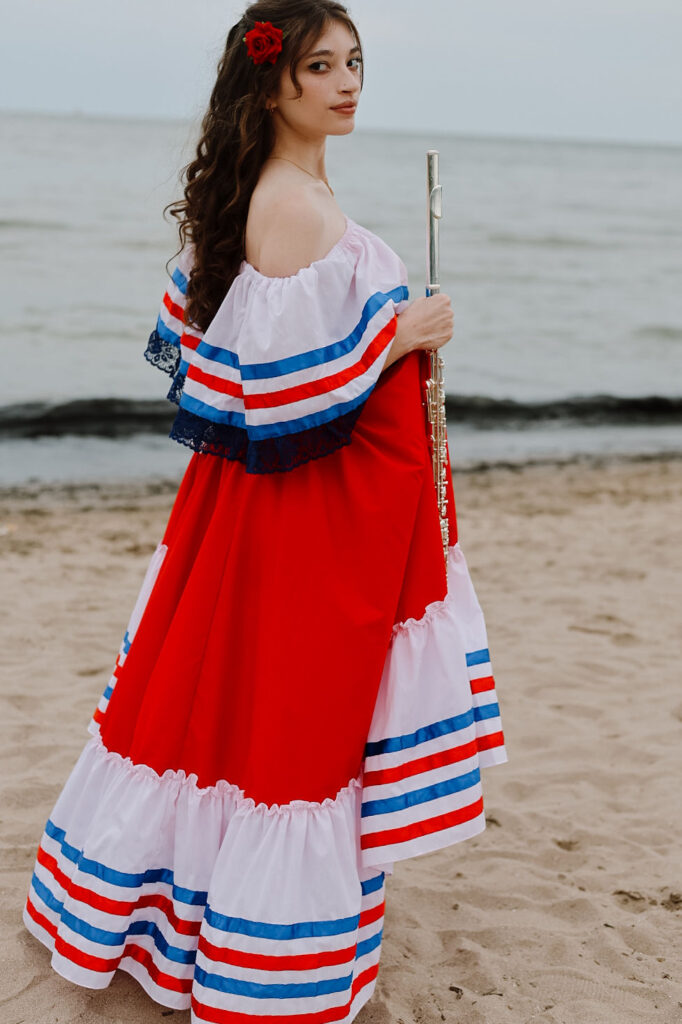
This guest post is by Helaina Taylor, a student and flautist who plans to study psychology and music. Helaina is applying for the Spring 2026 Making a Difference Autism Scholarship through KFM Making a Difference, the nonprofit founded by Kerry Magro. Kerry was nonspeaking until age 2.5 and was diagnosed with autism at 4.
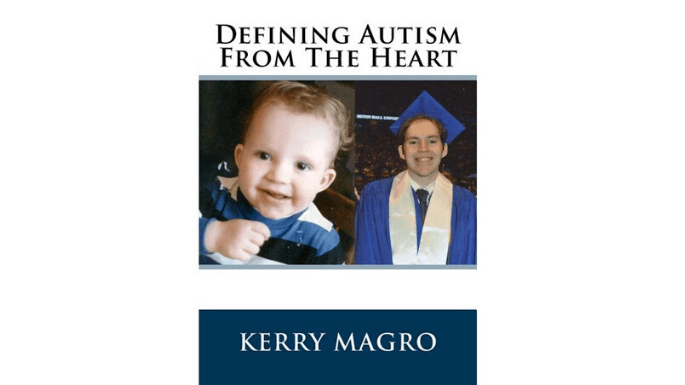
Autistics on Autism: The Next Chapter shares stories from more than 100 autistic adults about what helped them while growing up and pursuing their dreams. All proceeds support KFM Making a Difference initiatives, including this scholarship program. To invite Kerry to speak at your school, company, or organization, submit an inquiry here.
Helaina Taylor reflects on a childhood of feeling out of place and the self-understanding she found through a late autism diagnosis.
Gripping the arms of the swing, I observe the children around me. They are laughing, smiling, and enjoying themselves. You can say that we are just the same, but there are a few things that set us apart. These children have companions and never need to worry about being alone. Such were my worries as a late diagnosed autistic female during years of childhood.
There were a multitude of reasons why I had social difficulties; part of me enjoyed the solitude and wanted the world to myself. I enjoyed reading books on my own and creating my own narratives with Barbies. The other was the high likelihood of being misinterpreted. With my narrow perspective, my goal was to protect myself from bullying at a young age, but I was told that ‘sharing was caring.’ When the other children joined my session of play, I felt as if my personal space was being invaded. It wasn’t my story anymore. Thus began the beginning of my mask that I so seldom leave off.
Besides the school setting, difficulties presented themselves within my own home. Bluntness, meltdowns, and a failure to appear ‘normal.’ My father had been used to consistently getting his way without someone owning up; I was his competitor. I had been the ‘smart-ass’ and challenged his narrow-minded perspectives of me. I do wish that it had made me stronger, but it only caused more fear of displaying my voice. As I grew into my pre-teen years, I began questioning why he wouldn’t attempt to understand my perspectives. He was one of many adults I’d encountered that refused to listen to my reasons on account of miscommunications, and since then I have given up explaining myself: people who truly care about what I have to say will take the time to listen to my perspective.
Alternatively, there were some positives to my childhood that I later learned to be ‘special interests.’ I had an absolute fascination with anything feminine. I wanted to be a figure skater like Barbie in The Magic of Pegasus film, or a ballerina. I refused to wear any other clothes besides dresses and would wear tights beneath if the weather prevailed. I also had a passion for singing, which was quickly diminished by the burden of perfectionism. Academically, I believe that my ASD has contributed to my intellectual curiosity. I’ve been curious about the world and reading books since I was a baby.
On the other hand, bullying has been the worst part about being autistic, which has contributed to a consistent feeling of alienation. When I was in 2nd Grade, I seemed to be one of the only girls in my class that still enjoyed ‘girly’ things, those being Barbie, Monster High, and dolls. The other girls decided to lump themselves into ‘tomboys,’ and would make fun of and exclude me for not being one. The school system was not any better, eventually leading to my parents’ decision to move to a different city for a better school district. When children my age would hurl insults at me, I was too young to understand that my words changed nothing. However, I never understood why the blame was consistently put on me when I stood up for myself against bullies. I never fought back with violence, I simply defended myself with words, though the school system viewed this as ‘behavioral issues.’ I had to keep a behavioral chart during the 1st and 2nd grades of elementary school. The first involved either a sad or smiley face that would be given to me each class period. My punishment for receiving sad faces was to stand for an hour in the corner, per my father. One day, I decided to forge the behavioral chart and change the sad faces into smiles just to avoid punishment. I could not outsmart my father, and it resulted in an increased amount of time standing against the coarse sandstone walls of my house.
A year later following 2nd grade, my parents decided to send me to a Catholic school to improve my academic and behavioral performance. I hadn’t been raised with religion too often, but it was my great-grandmother’s wishes to have me baptized. Although my academic and behavioral issues improved, the feeling of alienation persisted. It seemed as if no matter where I went, I would still end up feeling like an alien.
Despite the feeling of alienation persisting as an 18-year-old writing this now, there have been countless improvements made to my life. It started while I was browsing mental-health videos on social media and came across videos discussing ASD. Previous explanations and support had not fully helped me understand my experiences. However, these videos made me feel more represented than ever before. Thus began another special interest of mine: psychology and mental health. I started to research symptoms of ASD in my own time and wondered if this was the missing puzzle of myself my whole life.
I began seeing a new therapist after moving through 2 previous ones, and she agreed with my consensus. I was put on a year-long waitlist for ASD Diagnostic Testing. In January 2025, I received my ASD Diagnosis, and it felt like a breath of fresh air. I’d finally be able to put a word to every struggle I’d face. I felt more confident about myself and who I was.
Although my journey of ASD posed many challenges, I wouldn’t be who I am without it. While being a psychology student, I intend to conduct more research on neurodivergent minds, and how we can make society more accommodating and accepting for everyone.
By Helaina Taylor
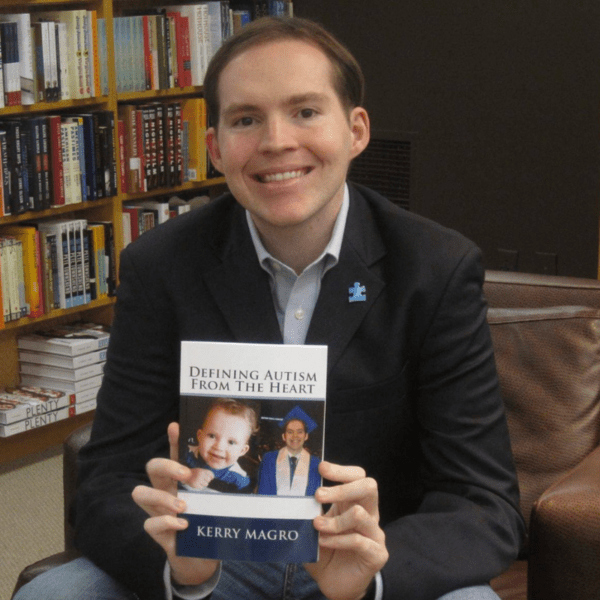
Kerry Magro, a professional speaker and best-selling author who is also autistic, founded KFM Making a Difference in 2011 to help autistic students receive scholarship support for post-secondary education. Help us continue this work by making a tax-deductible donation here.
You can also invite Kerry to speak at your next event by submitting an inquiry here. Kerry speaks with schools, businesses, government agencies, colleges, nonprofits, parent groups, and conferences on autism, employment, college success, mental health, inclusion, and bullying prevention.