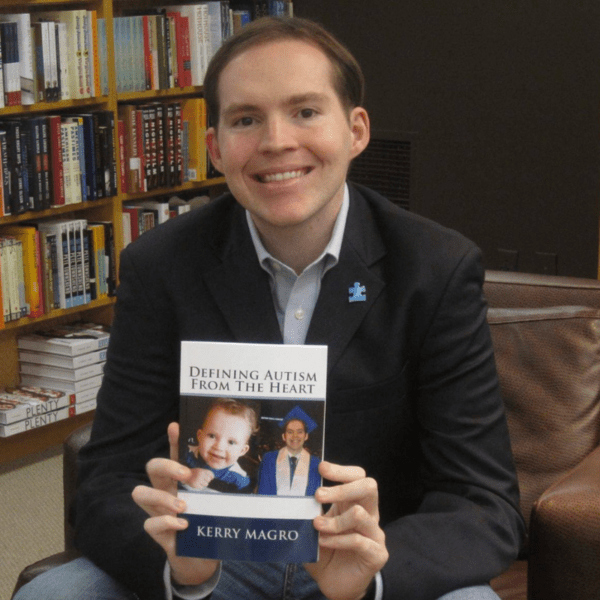

This guest post is by Sage, an autistic cultural anthropology student who hopes to teach at the university level and help address food insecurity. Sage is applying for the Spring 2026 Making a Difference Autism Scholarship through KFM Making a Difference, the nonprofit founded by Kerry Magro. Kerry was nonspeaking until age 2.5 and was diagnosed with autism at 4.
Sage is a pseudonym used at the applicant’s request. A stock photograph is used to protect their privacy.
Autistics on Autism: The Next Chapter shares stories from more than 100 autistic adults about what helped them while growing up and pursuing their dreams. All proceeds support KFM Making a Difference initiatives, including this scholarship program. To invite Kerry to speak at your school, company, or organization, submit an inquiry here.
As an autistic woman, I have learned that I am not defined by differences but instead see them as strengths and a beautiful way to navigate and change the world.
Often as an autistic child, I became overstimulated or overwhelmed. I came up with the saying: “let it roll” and said it every day to prepare myself for the day emotionally. A reminder that whatever happens, it would not be the end of the world. The phrase was utilized for my curious yet anxious mind to have a sense of emotional stability. For example, if a classmate used the last bit of purple crayon before me, I would “let it roll” and instead not let it affect the rest of my day. Later, the mantra evolved into a way to feel grounded, not to overthink, and to forgive myself. Today it reminds me not to wallow in what I should have done and empowers me to take everything less seriously.
I’ve always considered my neurodivergent mind a strength rather than a weakness, and not something that made me less than anyone else. Over time, I kept a list of famous faces who share the same differences as mine and are exceptional. I had no doubt that I, too, would achieve success. However, even the role models I admired could not dispel the ignorance and stereotypes that I would face growing up. People often made assumptions about me because my challenges are not always visible. I have been called “weird” by others and told that I could be “cured” one day if I worked harder or acted normal. Somehow on paper and in person, there is a big disconnect for people about me and what autism should look like.
These instances used to really shake me but now fill me with a sense of duty to continue to advocate for myself and to educate/encourage others to strengthen their own voices. It was at the end of high school when I learned to accept that difference didn’t mean less; it meant unique and original. By participating in school-based activism in the disabled community and sharing what I’d faced with district administrators, it allowed me to make a difference just by being an example.
This self-acceptance also allowed me to embrace my own nuances. “What’s that?” were the first-ever words that came out of my mouth. Ever since I was a baby, I was always known to ask questions about every little thing. Whether it be a peculiar-looking animal I saw or how human behavior functions, I was fascinated by it and its presence. I was never ashamed to pursue what I believed would satisfy my thinking for that day, even if it was a bit unorthodox for a 6-year-old. Driven curiosity was my motivation that allowed me to explore the world that surrounded me and make sense of it.
In my early childhood, I can still recollect myself checking out library books ranging from “The Diverse Food Groups of Peru” to “Norse Myths”, taking them home, hiding under my blankets, and attempting to read them all before I was forced to go to bed. My need to learn everything was urgent, even those that scraped the surface of my developing mind, or else it would shrivel up. Like an unquenchable thirst pulling at the depths of my understanding and drowning my judgment with various inquiries. My wonderment seemed to have no bounds.
Now at college, I really feel seen, capable and happy for one of the first times in my life. I am literally surrounded by others who love to ask questions and seek knowledge on a daily basis and it’s encouraged! I am a part of a disabled student union that focuses on improving the lives of students through a community so that our voices are not sidelined or isolated from each other.
As an anthropologist in the future, I know I’ll draw on my experiences serving others in the community for motivation. I hope to use them to address large-scale issues like food insecurity locally and globally. I plan to share my research and solution-based works with other multidisciplinary leaders and learners to begin to eradicate this problem on a larger scale. Along the way, I would very much like to mentor and support student groups, especially those with diverse learning needs, to join the cause because I value our unconventional ideas. I will make strong contributions as a teacher at the university level to inspire others to ask the very hard questions of society, but more importantly, search for the solutions as well.
Reflecting now, “Let it roll” has helped me leave my comfort zone, take more risks socially, and allow change to occur. The saying “Let it roll” was originally meant to help me experience my emotions; however, now it is a way to challenge myself and grow.
By Sage
Featured image: stock photograph by Mikołaj on Unsplash. It does not depict the applicant.
Kerry Magro, a professional speaker and best-selling author who is also autistic, founded KFM Making a Difference in 2011 to help autistic students receive scholarship support for post-secondary education. Help us continue this work by making a tax-deductible donation here.
You can also invite Kerry to speak at your next event by submitting an inquiry here. Kerry speaks with schools, businesses, government agencies, colleges, nonprofits, parent groups, and conferences on autism, employment, college success, mental health, inclusion, and bullying prevention.